

How To Repair A Broken Underground Water Line

We're back with our next Pro-Follow, and this one hits close to dwelling house. If you entered Fred'southward Husky Tool Tote Giveaway, you probably read the brief update at the stop where he shares that today's Pro-Follow comes to you from my firm.
Earlier this month, Jocie and I noticed that our h2o bill was significantly higher than usual.
Seeing goose egg awry in our home, we called the utility visitor expecting there had been a clerical error or possibly a malfunctioning water meter. Instead, they suggested we might take an surreptitious leak between our house and the meter, and they were right. I called a plumber I trust, and this commodity explains how he and his crew repaired the secret leak.
All of our Pro-Follow manufactures showcase professional contractors on actual job sites, and we share how they tackle home comeback projects with tips forth the mode. If you similar learning from the pros, go an email subscriber and never miss an update.
Steps to Repair a Broken, Secret Piping
The plumbers presented two strategies for fixing the leak. 1 approach would be to replace the unabridged length of copper pipe between my house and the meter by securing a cable at one end and pulling the erstwhile pipe and a new one (attached at the other end) through the basis. This would crave minimal excavation and less labor; however, copper is expensive and this solution would exist as well. I opted for the 2nd approach, which was to dig downward to the piping at the leak location and replace a small section of the pipe.
Pro-Tip: On newer construction, you may see black, high-density polyethylene (HDPE) pipe in lieu of copper, because it is less expensive.
Pro-Tip: Copper water pipe has an expected lifespan of l-lx years.
Pace 1: Have All Clandestine Utilities Marked
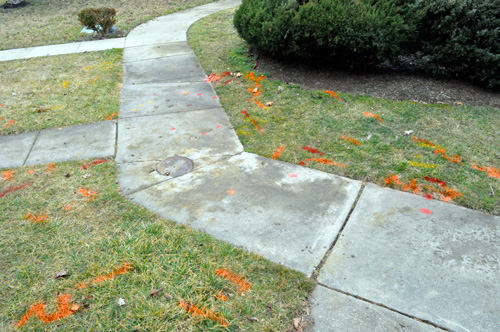
Upon closer inspection of my yard, the general location of the leak was pretty obvious because of the mud, only earlier piece of work could start, the plumbers needed all the hugger-mugger lines located. Here in Maryland, we telephone call Miss Utility earlier every dig. An Emergency Earthworks Notice was filed, and inside a few hours, all underground communications, gas, and power were marked.
Step ii: Plow off Water at the Main on the Street
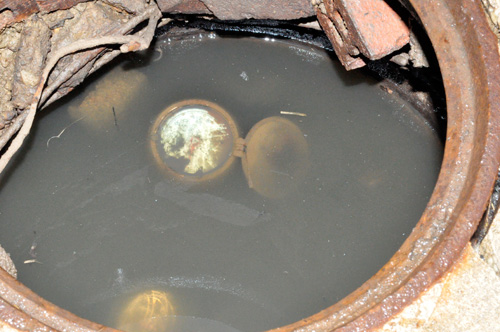
Start, they needed to plough off the water supply at the meter institute at the sidewalk. This motion picture shows the meter, which has been completely submerged past the leak. Judging by how fast the meter was moving, the leak was sizable.
[Encounter also: How to Plow off the Water at the Street]
Step iii: Hand Dig Downwards to the Leak Location
Unfortunately, power, water and communications all enter my house at most the same point (right effectually the leak), which meant that they needed to dig very slowly and carefully to avoid damaging anything.
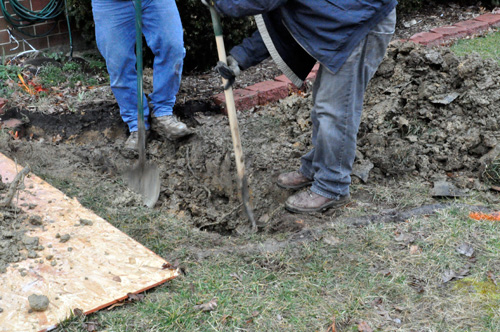
Pro-Tip: Communication lines like telephone and cablevision service are usually found within 24″ of the surface. H2o supply lines are typically cached 36-42″ deep, or deeper if y'all live in an extremely cold climate.
Pro-Tip: When excavation, orient your shovel along the buried line (rather than across) until it has been fully exposed. You lot're much less probable to inadvertently cause damage. Information technology should get without saying: never use mechanical tools to dig near underground utilities.
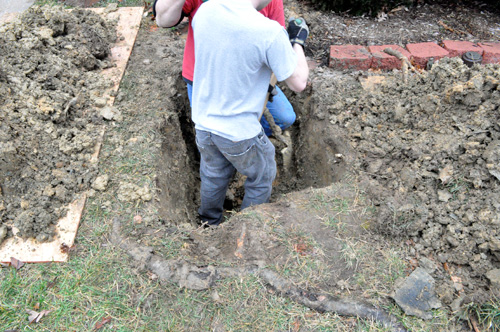
In time, they found black power lines, and they excavated around them to provide adequate clearance.
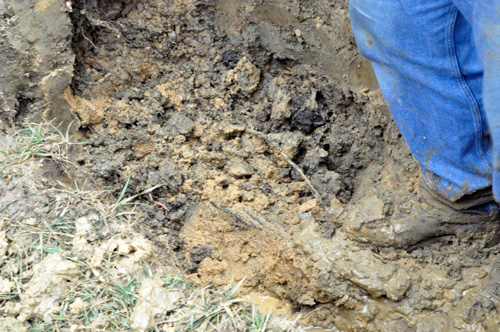
Step 4: Pinpoint the Location of the Leak
The plumbers would plow on the water supply for brief moments to help make up one's mind the location of the leak.
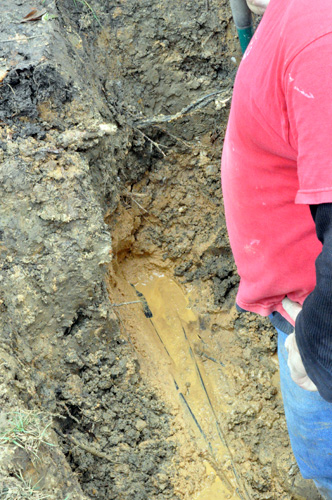
Eventually, they found the water line within a PVC sleeve. Builders would ofttimes run water supply lines through a short segment of PVC as it passed through the foundation, so it was odd that we should find the sleeve extended about seven′ away from the house. Upon turning on the water supply, it was found that the leak occurred somewhere inside this PVC sleeve.
Pro-Tip: While not the case in this home, in the late 80s builders frequently used a fabric called polybutylene for water pipage. This material was in one case thought of every bit "the pipe of the future" because information technology was flexible, easy to work with, and inexpensive. Unfortunately, the lifespan of polybutylene turned out to be relatively brusque (15 years). Ane repair method for failed polybutylene pipe is to run copper pipage through the polybutylene. If y'all meet a leak in an hugger-mugger supply pipe that looks like PVC, and your house was in the 80s, you should be aware of this potential situation.
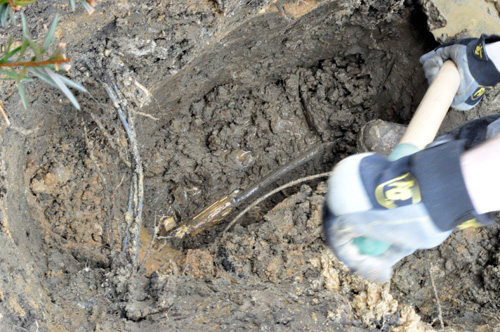
Step five: Cut Abroad and Remove the Onetime Pipe, Install the New Pipe
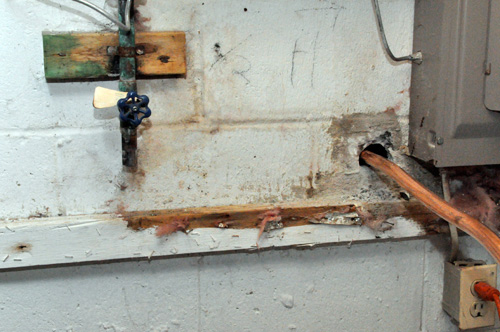
This close to the house, they determined it would be best to supplant an 8′ department going all the way inside. They cut the piping just before the PVC sleeve, and nosotros headed inside to cut and remove the former piping.
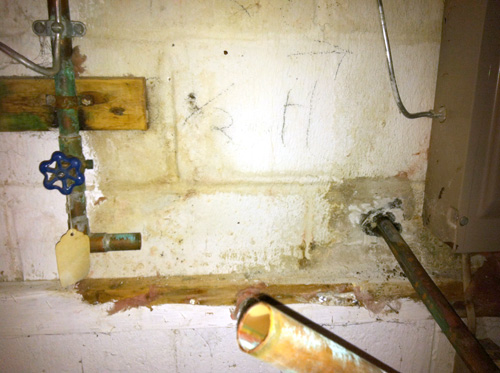
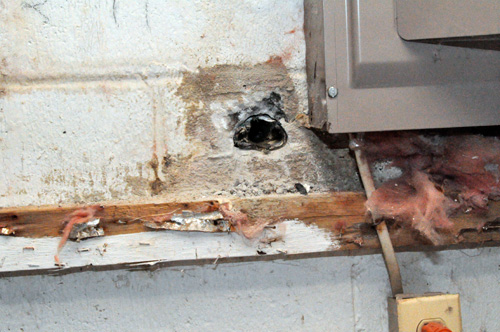
The crew attempted to push button a new piece of copper pipage through the hole and PVC sleeve, only it would not go. To feed the new line, they snaked a cablevision through the PVC sleeve. The plan was to solder a softer, more than flexible copper piping onto the cablevision and pull information technology through (much like the alternative approach I shared at the beginning.)
Hither's a flick of the new 3/four″, K copper supply line.
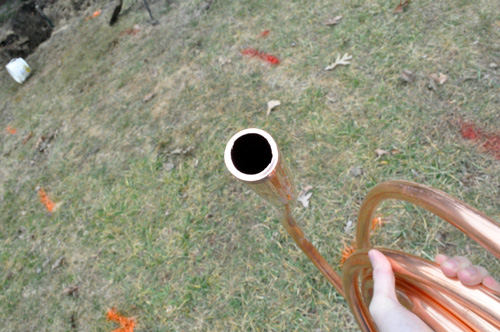
Pro-Talk: Copper pipage wall thickness is designated by letter K, L or 1000. Type Grand copper pipage is much thicker than L or M. Type L is the second thickest.
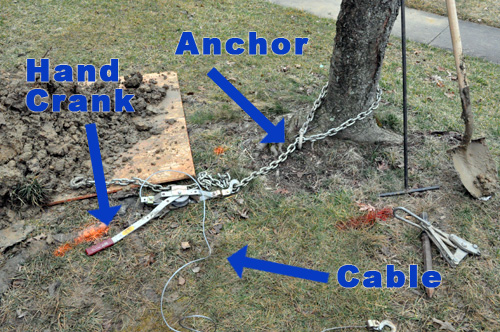
They soldered the pipage to a coupling fitted on the cable, and setup a winch exterior to pull the pipe through.
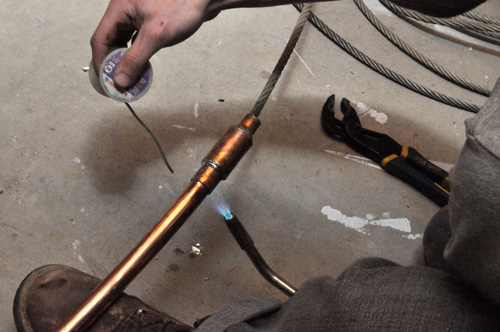
Pro-Tip: See our full tutorial to learn how to solder copper pipe.
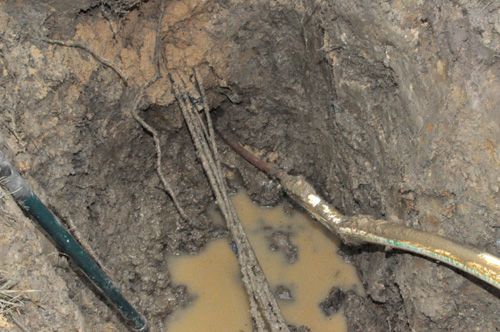
When everything was set, the crew began pulling the pipe through, and information technology actually dislodged the PVC sleeve. If you lot look closely at the motion picture below, you'll see a abrupt bend in the PVC. The plumbers are not certain how that occurred, merely that is definitely the reason why they could not feed the replacement pipe through by manus.
Pace six: Make Connections with the Existing Pipe
Step 6a: Outdoor Joints
A solder joint isn't appropriate for a cached line, and so instead they used a pack-joint coupling to connect the new piping to the existing supply line in the ground outside. Unfortunately, I don't have a flick of this step, just you can Google for pack-joint coupling and discover a skilful corporeality of information on information technology. Next, they turned on the water to affluent out whatever dirt or debris.
Step 6b: Indoor Joints
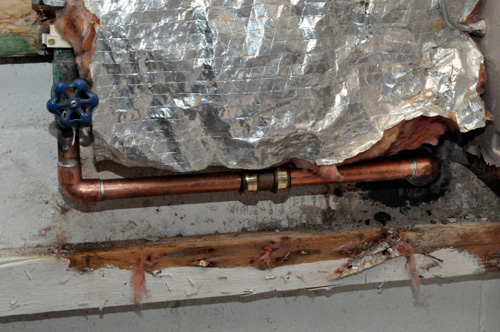
Adjacent, the crew went about connecting the new line inside my firm, which involved uncomplicated copper soldering. If you're curious nigh that fitting in the middle, it's a compression fitting called a SharkBite. When they installed the new, 90° elbows, one of the joints wasn't properly soldered. When they turned on the water, a small pivot-hole leak was evident. Unfortunately, it'south incommunicable solder a piping when it'due south full of water. To address this, they cut the pipage in the middle, drained the water, re-soldered the elbow and then used a SharkBite (which doesn't require soldering) to repair the cut. In Maryland, SharkBite fittings are fully code-compliant for indoor utilize.
Stride seven: Seal up the Pipage Entrance Points into the House to Prevent Leaks
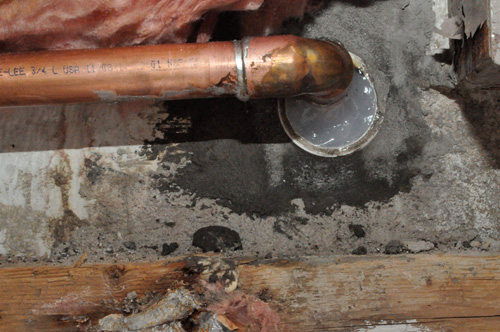
Here'southward a closeup showing where the pipage enters my business firm. You lot can come across the plumbers placed a new PVC sleeve that extends a few inches beyond the foundation, and they used a articulate, silicone sealant to make full the space around the copper pipe. They besides used a hydraulic cement to repair the surface area effectually the PVC sleeve.
Step eight: Check and Confirm That the Pipes Are Leak-Free
The coiffure re-tested the line and confirmed that the pipes were leak-free.
Of form, they repaired the front lawn, and I'll be reseeding the expanse in the next few days.
If you enjoyed this article, check out some of the other Pro-Follows nosotros accept going on correct now.
Source: https://www.oneprojectcloser.com/how-to-repair-underground-water-pipe/
0 Response to "How To Repair A Broken Underground Water Line"
Post a Comment